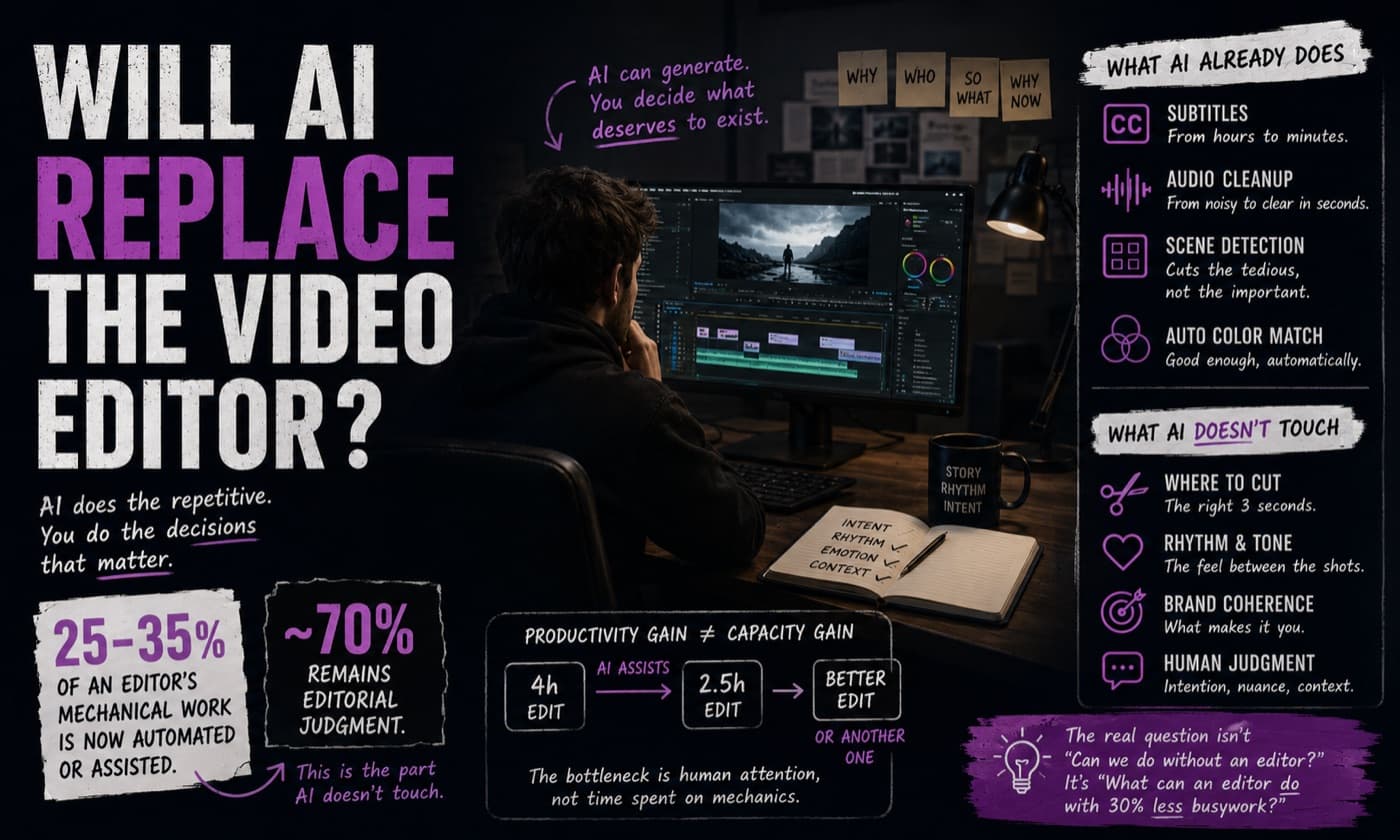
The question has come around at regular intervals since 2023, and even more since generative video models arrived. Is it still worth hiring an editor, or do you just wait twelve months for the tools to take over? The answer is less binary than the two camps fighting it out on LinkedIn would have you believe.
AI has reshaped a real part of post-production work. It hasn't touched the other part, and that part is precisely the one that counts.
What AI has already absorbed
Automatic subtitling works. Not just speech-to-text, which has been solved since Whisper, but also placement, segmenting into readable chunks, frame-accurate sync. The tools built into Premiere, DaVinci, or third-party solutions like CapCut produce usable subtitles in a few minutes for a video that would have taken an hour three years ago.
Audio cleanup is in the same category. Adobe Enhance Speech, DeepFilterNet and their competitors produce a clean voice track in seconds — one no one could clean up manually in under an hour.
Automatic grading on simple shots, scene detection for chunking long footage, interview transcription, first passes of color matching across shots: all of that has become reliable and fast.
In total, probably 25 to 35% of an editor's hours on a standard corporate format are now either automatable or assisted to the point of being near-instant.
What AI doesn't touch
The rest is editorial judgment. And editorial judgment is precisely what AI doesn't do — not because the models aren't good enough, but because there's no clear training signal for what it should be optimizing for.
Where's the right place to cut, in a fifteen-minute interview that becomes a ninety-second one? Which three seconds out of nine hundred capture the central idea? What rhythm to set between two consecutive shots? Which silence to keep, which breath to let through, which "uh" to drop because it weakens and which to keep because it humanizes? Those choices are narrative decisions, and they depend on an intent no one has written down anywhere.
Same goes for brand coherence. A visual identity can be encoded. A rhythmic identity, an editorial cadence, the tone expected on one channel versus another — those things are implicit and held by the humans who do the work. AI can imitate a previous video. It stays at a distance from what makes you want to watch the next one.
The productivity gain doesn't create the capacity people think it does
It's the most common reasoning error. "If AI saves 30% of the time, then the team can produce 30% more."
No. A team going from a four-hour edit to a two-and-a-half-hour edit hasn't gained an hour and a half of capacity. It has gained an hour and a half of mechanical time, during which the bottleneck is still human attention — and human attention hasn't gotten more available. The editor who saved ninety minutes on subtitling spends them on what? Either they do another edit, and yes, the gain is real. Or they make the current edit better, and the gain ends up invested in quality, not in volume.
The first option only holds if the request pile is infinite and context-switching is free. In practice, that's rarely the case. The second option, more likely, doesn't free up capacity in the sense people mean in budget meetings.
The real question
AI is going to shift what an editor does. Fewer mechanical tasks, more editorial judgment, more format experimentation, more versions, more care per deliverable. That's what every field where automation arrived ahead of us calls a level-up of the remaining work.
So the right question for an organization isn't "can we do without an editor thanks to AI." It's "what could an editor freed from 30% of mechanical tasks do that's more useful?" The answer requires an editorial project, and an editorial project requires someone to carry it. That's exactly the position you were trying to cut.