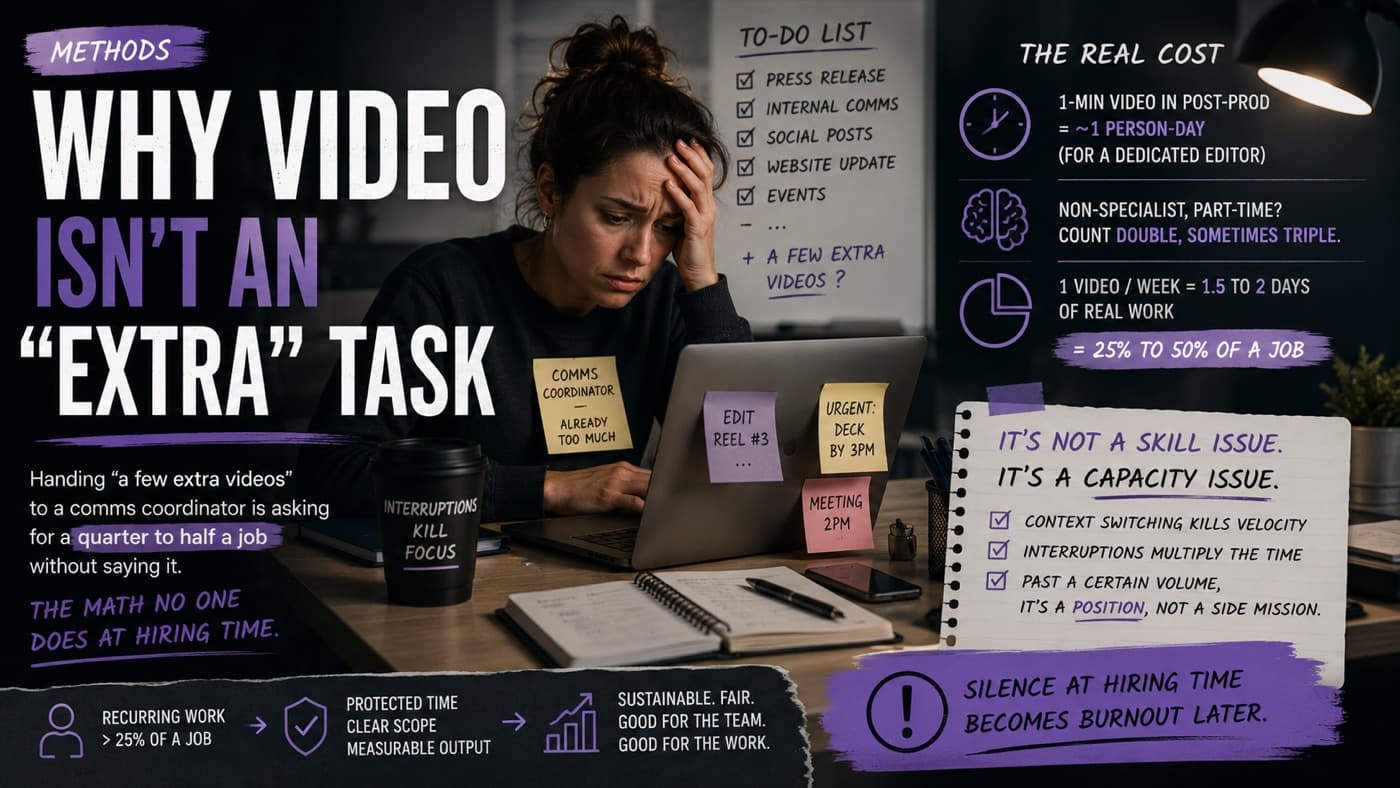
The line comes around at regular intervals in organizations that don't have a dedicated video team, or whose team is saturated. "Could you make a few extra videos on top of your job, it would really help us out." The target is usually a communications coordinator, a marketing apprentice, a community manager who already films or edits a bit on the side. They say yes because they want to be useful, because the request is framed as light, and because the math that should be done isn't on their mind.
Nobody does the math. That's what this article is about.
"A few videos a week" is between a quarter and a third of a job
A one-minute video in post-production demands, for a trained person who does only that, about a day's work. That's the coefficient detailed elsewhere: around 0.8 videos delivered per post-production person-day on a standard corporate format, in a multi-channel in-house team.
That coefficient assumes a dedicated profile. Someone who opens Premiere or DaVinci every morning, who has their workflow set up, their presets, their shortcuts, their asset library, and most of all walks into the session with the project context already in working memory. For someone who sits down twice a week between two other tasks, the coefficient collapses. Counting double, sometimes triple, is a realistic calibration.
One video per week, at a degraded coefficient for a non-specialist, comes out to between a day and a half and two days of effective work. On a 35- or 40-hour job, that's between a quarter and half the time. Adding "video content creation" to the job description without removing anything else amounts to silently asking for an existing responsibility to be done in less time. That silence is exactly what poisons what comes next.
Mental context costs more than the hours
If the cost came down to hours on a timesheet, you could at least budget it. The real problem is elsewhere.
Post-production demands continuous concentration. You step into a timeline, load an editorial intent, tune a rhythm down to the frame, make aesthetic decisions on micro-details an untrained eye doesn't see. That state of focus takes twenty to thirty minutes to reach, and it collapses at the first serious interruption. Urgent email, unavoidable meeting, Slack ping from the boss asking for a brief on something else: the session is wrecked, you have to start over.
A dedicated profile protects that concentration because it's their job. A multi-purpose profile, by construction, can't protect it. Their day is made of the interruptions they have to answer. The result isn't a worse edit, it's an edit that takes three times longer than it should, because you pick it back up five times instead of doing it once.
On top of that mechanical fatigue is the fatigue of constant trade-offs. This person has to choose, several times a day, between making progress on the video or on their other duties. Neither choice is satisfying: they're behind on the video if they handle their inbox, behind on their inbox if they edit. The frustration produced by that ongoing arbitration is the most important invisible cost, and the one no job description ever mentions.
Skill is a smokescreen
The easy objection to all of the above is to push the subject back onto technical ground. "With a bit of training, it's doable — plenty of people edit Reels without being pros." That's true, and it's exactly why the skill argument doesn't hold.
The problem isn't that a comms coordinator couldn't edit a decent video. Many could, and some do it very well. The problem is that they can't edit them at the volume being asked, in the time they have left, without breaking the rest of their job. It's a capacity question, and capacity questions aren't solved by training, they're solved by a position.
It's also why the promise "we'll give them the tools, AI will help, it'll go faster" misses the mark. Tools accelerate part of the work. They don't create available brain time. Someone going from a four-hour edit to a two-hour edit thanks to a tool is still being interrupted for those two hours. The gain is real but marginal compared with the slope of context-switching.
Past a certain volume, it's a position
There's an organizational logic behind all this, and it's simple. When recurring work represents more than a quarter of a job, that work is a job. Not a side mission, not a shared responsibility, not a cross-functional skill. A position. With its protected time, its defended scope, its measurable deliverable.
Refusing to see it that way amounts to outsourcing the organizational cost onto the person who said yes. They absorb the fatigue, they absorb the frustration, they absorb the quality drop that would never have been accepted from an outside vendor. And the day they break, the conclusion is "video is complicated" — which was never the subject.