It's the trade-off every organization ends up facing once video volume rises. Should you hire someone in-house, or keep going through freelancers? The intuitive answer looks like an hourly-cost calculation, and that's exactly why it almost always gets it wrong.
The pure-cost break-even
Let's start with the naive calculation, because it's the baseline.
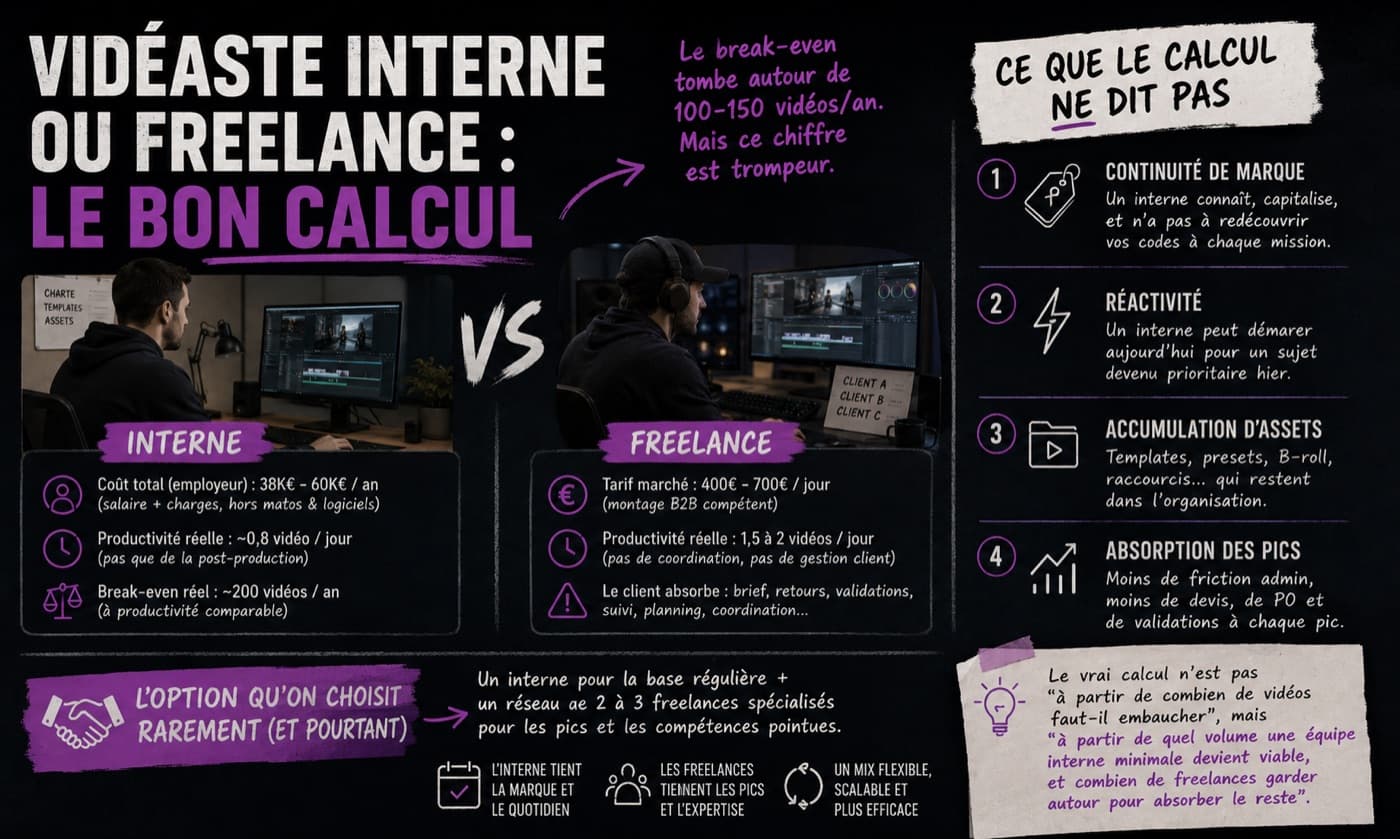
On the freelance side, market surveys (Malt, École des Vidéastes) put day rates around €400 to €700 per day for a competent B2B editor, depending on whether you're hiring for pure editing, full direction, or motion design.
On the in-house side, Indeed and Glassdoor data put gross monthly salary between €2,200 and €3,500 depending on experience — which means an employer cost between €38,000 and €60,000 per year with social charges, excluding equipment and software.
On the naive calculation, at equal productivity, break-even lands around 120 videos per year against a median freelancer. But that equal-productivity assumption is exactly the trap.
A freelancer doing nothing but post-production holds a pace of one and a half to two videos per day. An in-house generalist, who also has to coordinate, shoot and handle feedback, drops to around 0.8 videos per day. On pure volume produced per euro spent, the freelancer can outperform what the raw calculation suggests, and the real break-even climbs closer to 200 videos per year.
Except that productivity gap doesn't come from nowhere. When a freelancer only does post-production, it's because they've offloaded onto the client all the coordination an in-house person absorbs across their day: briefing, approval, feedback, contributor follow-up, schedule alignment. Someone on the client side has to do that work, and that someone costs the organization too. The cost exists without showing up in the €500/day invoice.
So the pure-cost calculation doesn't actually settle the question.
What the calculation doesn't capture
The trouble is that the calculation ignores four things that weigh as much as direct cost.
The first is brand continuity. A freelancer, even an excellent one, brought back twice a year re-discovers your brand system, your templates, your approvers, your tone. A freelancer brought back every week knows all of it. An in-house person, full-time on the brand, doesn't have to re-discover any of it and can invest the time saved in more useful things.
The second is responsiveness. An in-house person available in the morning for a subject that came up the night before is real value. A freelancer, by construction, has other clients and their calendar has to be negotiated. For opportunistic or reactive subjects, the responsiveness gap is significant.
The third is asset accumulation. An in-house person producing 200 videos over a year builds, along the way, a library of templates, presets, effects, reusable B-roll, shortcuts that compound. That library belongs to the organization and keeps serving after the person is gone. A freelancer accumulates that library for themselves, and puts it at the service of every client they have.
The fourth is peak absorption. An in-house person saturates at some point, which can be quantified in person-days. But below that point, they absorb variation without anyone having to negotiate a quote. A freelancer, at every peak, requires a quote, a PO, a budget approval. The administrative cost of that friction is never invoiced but it consumes managerial time that shows up nowhere.
The option people rarely pick
The in-house vs freelance calculation is, in reality, a false dilemma. The right setup, past a certain volume, combines both.
An in-house person covering the regular baseline, and a network of two or three specialist freelancers you call in for peaks or for skills the in-house person doesn't have (heavy motion design, sound design, complex multi-cam event capture). The in-house person holds the brand and the day-to-day, the freelancers hold the moments when you need more, or more specialized work.
So the calculation to run isn't "how many videos before you should hire," it's "at what volume does a minimum in-house team become viable, and how many freelancers do you keep on retainer around it to absorb the rest." That question is harder. It's also almost always the right one.