The moment recurs, with small variations, everywhere a video team serves several brands or several channels. In-house in a group, in a social media agency, in a production company with a client portfolio. Someone in a meeting notices that a new channel would be relevant. A dedicated LinkedIn page, a brand that had no presence, an emerging format worth testing. The suggestion is light to make, harder to turn down, and the video team accepts because it doesn't know how to put a number on what it costs.
The cost isn't material. No one is going to buy another camera to open an extra channel. The cost is somewhere else, in an equation few organizations lay out explicitly.
Capacity, coverage, frequency: pick two
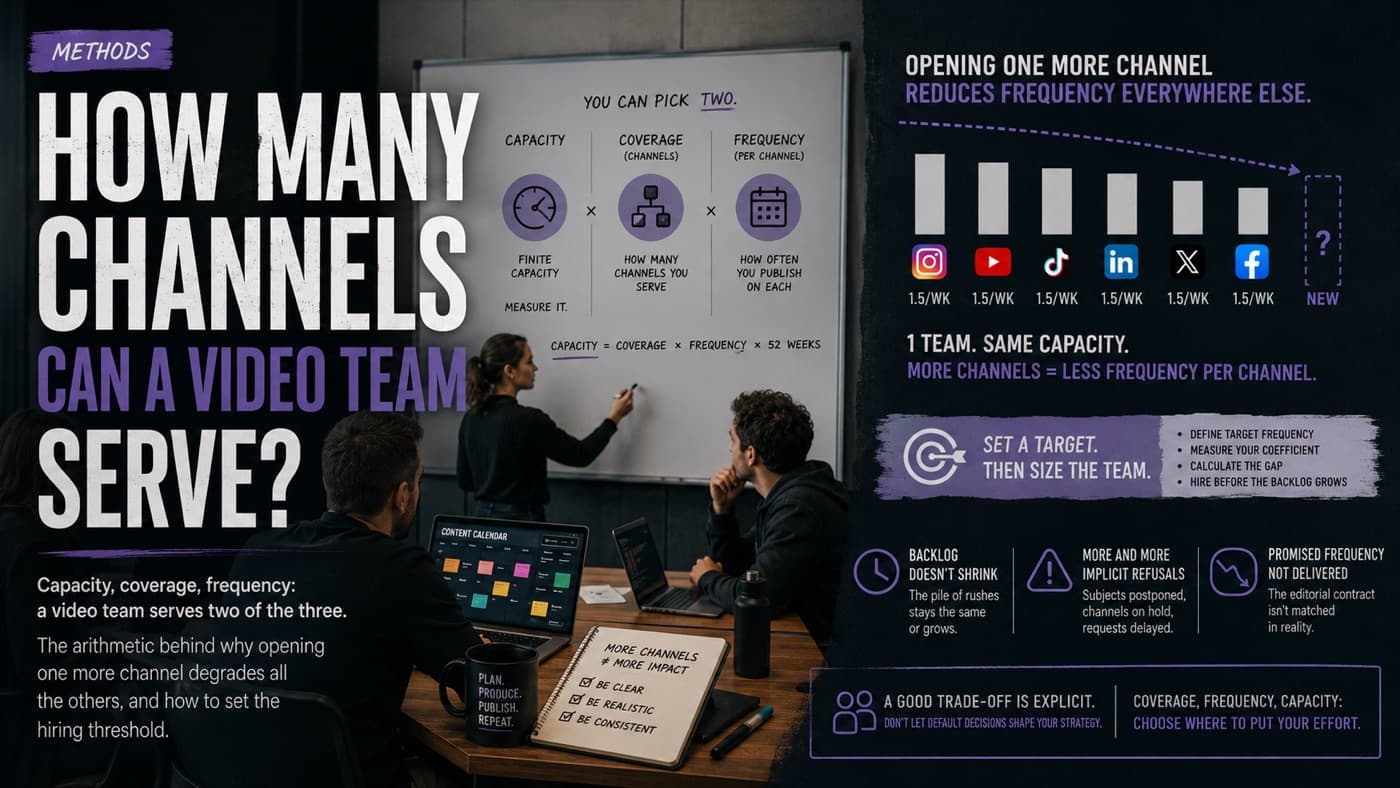
A video team, at constant composition, has a finite yearly capacity. You can measure it simply, in post-production person-days multiplied by a productivity coefficient. That capacity then has to be distributed across two things: coverage (how many channels you serve) and frequency (how often per week you publish on each).
The arithmetic is elementary. Capacity = Coverage × Frequency × 52 weeks. As soon as you fix two of the three variables, the third falls out by subtraction. A team producing 220 videos per year that serves seven channels, for example, won't exceed one post per channel every week and a half. Not because it's bad. Because there isn't more.
Those numbers aren't negotiable. Someone commissioning the work who wants to both expand coverage and hold frequency is implicitly asking for a capacity increase — which means more team. Someone who wants to cover more at a fixed team size is implicitly asking for a frequency decrease, which then has to be announced to the brands concerned. Nobody spontaneously offers to pay for the third option, so nobody sees it, and it imposes itself by default as under-served brands.
Adding a channel costs more than people think
Part of the misunderstanding comes from marginal reasoning. When you add an eighth channel to a team that already serves seven, the intuitive argument is that it doesn't change much. The team already films, already edits, already publishes. One more channel is just another distribution outlet for content that would have been produced anyway.
That's wrong on two levels.
The first is that an extra channel doesn't make do with the same production re-broadcast. By construction, it has its own editorial line, a format adapted to its platform, a cadence that has to be held. If that weren't the case, there would have been no reason to open the channel. So each added channel demands, if not a dedicated production, at least a production adaptation that consumes post-production time.
The second level is that dilution is mathematical. At constant capacity, opening one channel divides per-channel frequency across all the others. The degradation doesn't hit the eighth channel you just opened: it hits the previous seven. And losing frequency on a mature channel — one that had built its rhythm and its audience on a steady cadence — can undo in a quarter what it took a year to build.
That's why opening a new channel is, in reality, a decision that concerns all the existing channels.
Centralizing doesn't create capacity, it pools it
The case for centralization is often framed as a productivity argument. A centralized team would be more efficient than seven local ones. That's partly true, but the efficiency you gain isn't the one people think.
What you gain by centralizing is, first, the pooling of idle time. A local team dedicated to a single brand has, over a year, slow weeks where there's little to produce. Those weeks are lost, because capacity doesn't carry over. A centralized team serving several brands absorbs those waves: when one is quiet, another is peaking, and the team stays fully used.
You also gain, and this probably matters more over time, the ability to specialize. A single brand doesn't have the volume to justify a full-time motion designer, and even the roles you mobilize only occasionally — color grading, sound design — need regularity so a freelancer learns your standards instead of being reset every project. A team that pools several brands adds those workloads up, hits critical mass to bring a motion designer in-house, and gives outside specialists enough volume to stay current. The qualitative jump is less visible than the productivity gain, but it shows on screen.
These gains are real, but bounded. They don't create capacity in the strict sense. They prevent wasting it, and they let you invest the existing envelope in better-targeted skills. Once those two benefits are captured, you're back to the arithmetic of the first section: a fixed total capacity to distribute between coverage and frequency.
The other consequence, less often raised, is that centralizing forces collective trade-offs. When seven brands share a team, their priorities collide in planning meetings. The most demanding brand takes time others wanted. One brand's peak pushes another's deliveries back. A local team, by contrast, doesn't have to arbitrate because it serves a single party. Centralizing means gaining efficiency at the cost of a political workload someone has to carry, and that consumes managerial time no spreadsheet ever bills for.
The hiring threshold is calculable, provided the target is set
At some point, the equation becomes untenable and you have to grow the team. The question is when exactly, and the good news is that it's measurable.
Three signals converge once the threshold has been crossed. The first is a post-production backlog that doesn't shrink. At constant input rate, if the pile of unprocessed footage doesn't go down over two consecutive months, the team is saturated. The second is the frequency of implicit refusals: subjects that no longer get tackled, channels left on standby, requests answered with "not before next quarter." Those refusals are hard to spot because they're diffuse, but they're the real indicator of tension. The third is the gap between promised and delivered frequency. If the editorial contract says "two posts per week on this channel" and you deliver 1.2 on average for the quarter, the team is undersized.
The hiring calculation derives from the target capacity and the coefficient measured on the existing team. It varies from team to team, and that's exactly why you have to measure your coefficient before claiming to size anything.
Before the calculation, though, there's the strategic question. A team that can't hold frequency across thirteen channels may be undersized, or may simply be signaling that those thirteen channels were never thought through. Hiring to serve them only makes sense if they have a strategic reason to exist — meaning they contribute to a marketing objective that is identified, measurable, and defensible. When that reason is missing, it's coverage that has to be questioned before team size.
The tempting alternative at that point is to avoid the hire by asking someone else in the organization — a communications coordinator, a marketing apprentice — to take on "a few extra videos". It's a false economy, for reasons less obvious than they seem, and worth looking at in detail.
A good trade-off is explicit
The three-variable equation isn't solved by optimization, because there's no function to optimize. It's settled by decision: you choose where to put the capacity, and you own that choice. A brand that will get few posts has to know it, and the team has to have said so. A team adding a channel has to have spelled out what it will lose elsewhere. An organization that wants to both cover and post often has to have budgeted what that costs in team size.
A bad trade-off isn't one that picks the wrong variable. It's one that's never made explicit. What's left is figuring out who, in the organization, has the standing and the reflex to put it on the table before it gets settled by default.