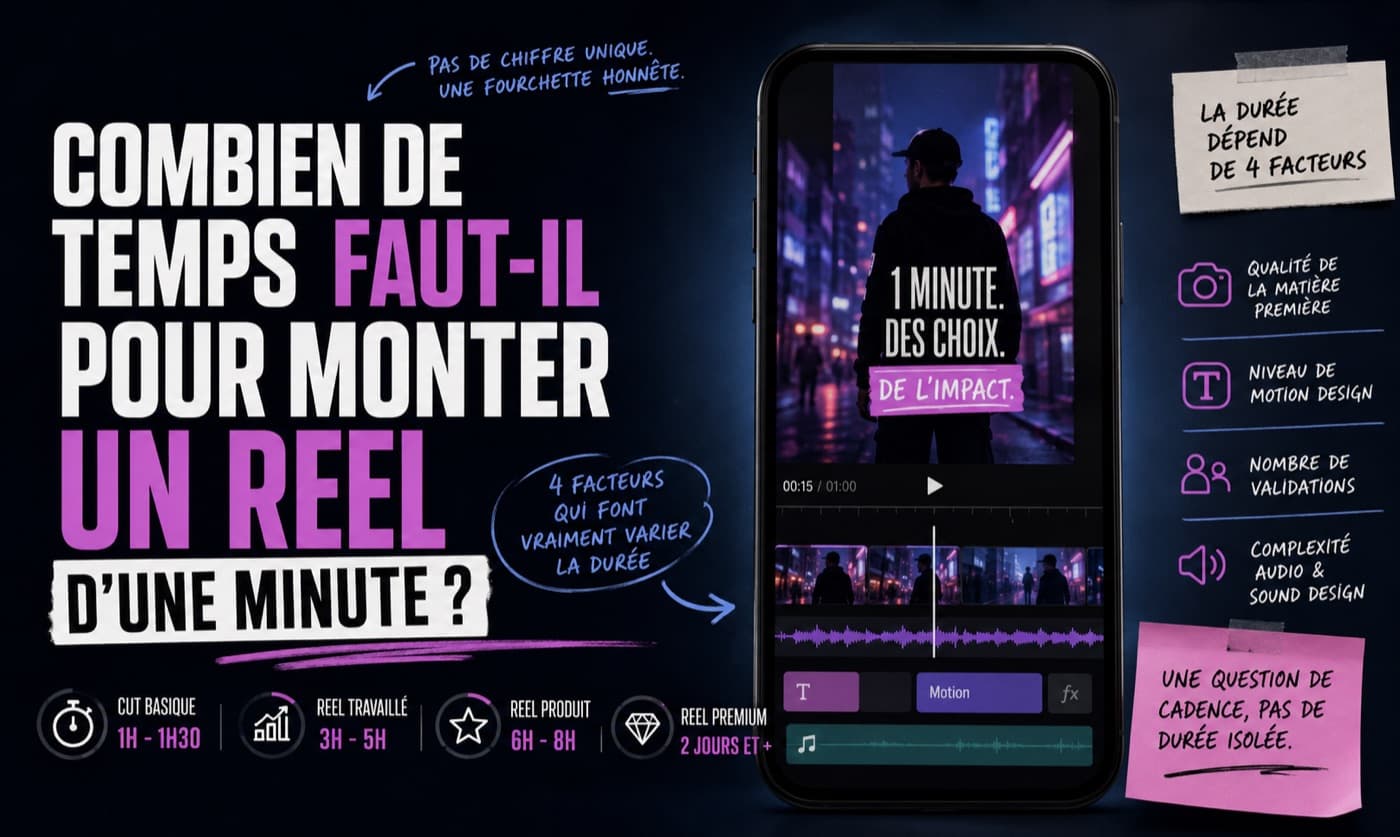
It's probably the most common question asked of a video editor, and also the one with the most wrong answers. The trap is in the phrasing: you're looking for one number, and there isn't one. The same request — "edit me a one-minute Reel" — covers objects whose production time varies by a factor of ten.
Here's the honest range, and what tips you from one tier to the next.
A note before the numbers. These ranges come from tracking an in-house corporate team that produces around 220 videos per year, multi-channel. There's no industry standard for this kind of measure; what follows is a field benchmark, to be taken as such.
From 1 hour to 1 day, depending on what you call a Reel
The basic cut. A vertical video shot on a phone, two or three takes, text overlaid on top, no licensed music, no motion graphics. Someone trained in CapCut or Premiere ships that in an hour to an hour and a half. It's the format used by brands that "make Reels" without really having made any.
The worked Reel. Seven to fifteen takes pulled from multiple sources, transitions cut on the beat, dynamic text, a quick color pass, a recognizable intro and outro. For a dedicated profile, that's three to five hours. It's the standard for a brand that takes social seriously but hasn't yet locked down a strict visual identity.
The produced Reel. Light motion design on the titles, brand guidelines that are actually respected, graphic assets cleanly integrated, sound design with occasional accents, one or two final versions. You're now at six to eight hours of effective post-production — a solid day. The vast majority of Reels published by B2B brands with an in-house video team fall in this tier.
The premium Reel. Custom animation, illustrations, recorded and processed voice-over, fine audio post-production, several rounds of client approval. You easily go past two days, and you can climb to a full week when you combine heavy color grading, fine audio mixing, heavy motion design and several technical contributors. It's the tier you see in B2C brand campaigns, and at that point it's no longer really a social Reel — it's an ad in vertical format.
What actually moves the duration
At equal finish level, three factors move the dial non-trivially.
First, the quality of the raw material. Sorting two hours of footage down to one minute means several hours of viewing just to make the choices. Shooting tight, with a precise intent, mechanically cuts post-production time. Conversely, footage with bad lighting that has to be rescued in post can double the grading time, and horizontal footage you have to reframe for vertical imposes shot-by-shot cropping work — and even quality loss when you have to zoom into the frame.
Next, the level of motion design. A title that animates cleanly within the brand system takes thirty minutes the first time and five minutes by the hundredth, because the template has been built. Without a template, every title is a one-off.
Finally, approvals. One version sent, approved, delivered: that's the nominal duration. Three rounds of feedback, each with its tweaks, can double the total time without changing the final deliverable at all.
The real question
"How long does it take to edit a Reel" is a useful question for a freelancer billing per piece. For an in-house team or an agency producing continuously, it's badly framed. What matters isn't the duration of any one Reel, it's how many Reels a team can ship per post-production person-day over a year.
That measure is the only one that holds up under a mix of finish levels, seasonality, and approvals that drag on forever. It's also what lets you size a request in person-days rather than deliverables, and therefore say no when you have to.