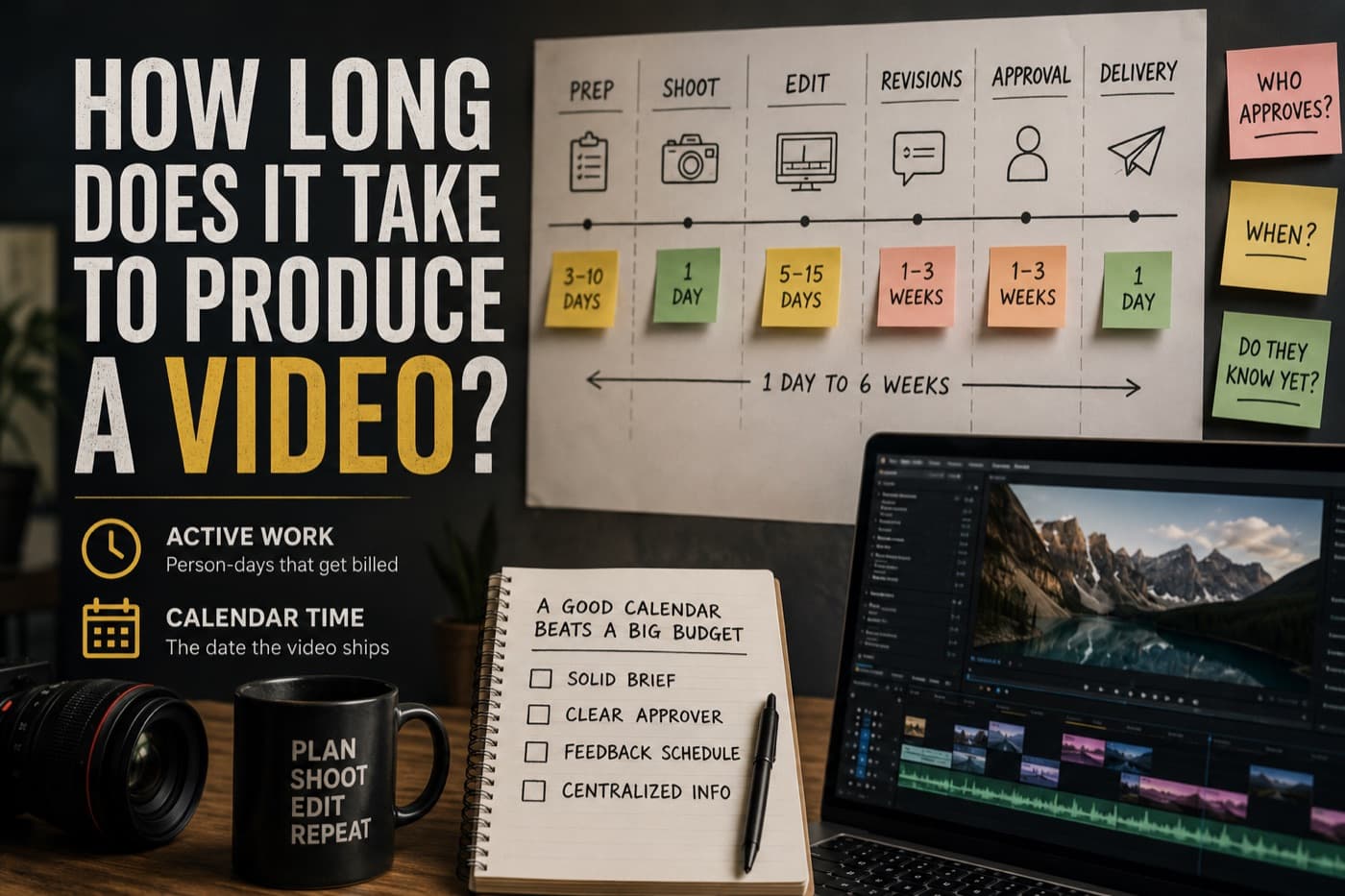
The question always lands at the end of the meeting. We've talked about the brief, the topic, the angle, and then someone tosses it out, almost in passing: "So when can you have it ready?" The video is 90 seconds long. The answer should fit into a day. Except it doesn't.
After several hundred productions, the gap between how long the deliverable runs and how long it takes to exist is the most stubborn misunderstanding in commissioned video. And the mistake starts in how the question is phrased: there isn't one production time, there are two. The actual work (the person-days that get billed) and the calendar time (the date the video ships). The two have almost nothing to do with each other.
| Type | Screen length | Active work | Calendar time |
|---|---|---|---|
| Social short (Reels, Shorts, TikTok) | 15-60 s | 4 to 12 hours | 1 day to 2 weeks |
| Simple talking-head interview | 2-5 min | 2 to 4 person-days | 1 to 3 weeks |
| Corporate video (interview + b-roll) | 2-3 min | 7 to 12 person-days | 3 to 6 weeks |
| Animated explainer | 60-90 s | 12 to 18 person-days | 6 to 8 weeks |
| Tutorial / training | 5-15 min | 2 to 5 person-days | 2 to 4 weeks |
The active-work ranges are wide on purpose. Production level can swing the effort threefold within the same format. A Reel shot on a phone, cut straight, posted: 4 hours. The same format with a written script, controlled lighting, color grading and motion design: three person-days. And every layer of finish brings its own round of approval, so the calendar drifts even faster than the effort does.
For a polished 2-minute corporate video, expect about ten person-days of work, spread across six weeks of calendar. The rest, twenty-plus working days, is waiting. Not hidden work. Not prudent buffer. Waiting.
Wyzowl, who have been doing animated explainers for thirteen years, quote six weeks for 60 to 90 seconds. Not because they're slow: because a clean animation is a script, a storyboard, a voiceover, assets, animation, a mix, and several rounds of feedback. Each step waits on the previous one. Each round of feedback waits for the right person to find fifteen minutes.
The shoot rarely takes more than a day
Camera, lighting, crew on location: that's the most visible part of the production, and the shortest. A standard corporate shoot wraps in a day. Total active work wraps in one to two weeks. The calendar plays out somewhere else.
Before: the brief is never as solid as people think. The objective sharpens halfway through scriptwriting. The script gets revised once the first draft lands. The interviewee asks to rephrase a question ten minutes before the interview. Each adjustment costs little work. But each one adds a cycle: send, wait, receive, integrate. It's the cycles that hold the calendar, not the working hours.
After: the video waits to be watched, for feedback to come back, for someone to arbitrate when two approvers disagree. This isn't a goodwill problem. The person approving has a calendar that wasn't built around watching V1, V2, V3 of a video. To them, it's an extra task. They take the time they take, and that time, not the editor's, is what sets the delivery date.
Across ten parallel projects, this is no longer friction. It's the job.
The main constraint is not the budget
Wistia's State of Video 2026 report finds that 76% of companies publish at least one video a month, with the most active teams shipping several a week. The same study identifies team size and resource availability as the top blockers. Ahead of budget.
That tracks. Doubling the budget pays for a better art director, a better editor, better sound design. It does not get the approval committee to meet a day earlier. It does not stop the client from changing their mind on the angle after the rough cut. Budget buys person-days. It doesn't buy calendar.
What buys calendar are unglamorous things. A written brief that gets read together before the shoot and isn't reopened afterwards. A single final approver, named upfront. A feedback schedule set in advance, with actual dates rather than "as soon as possible". One central place where the state of every project can be read without anyone having to ask.
None of that shows up on screen. All of it changes the calendar by a factor of three.
The useful question isn't "how much work does this take". It's "who approves, when, and do they know yet". If those three answers exist on the day of the shoot, the right-hand column holds. If not, double it.