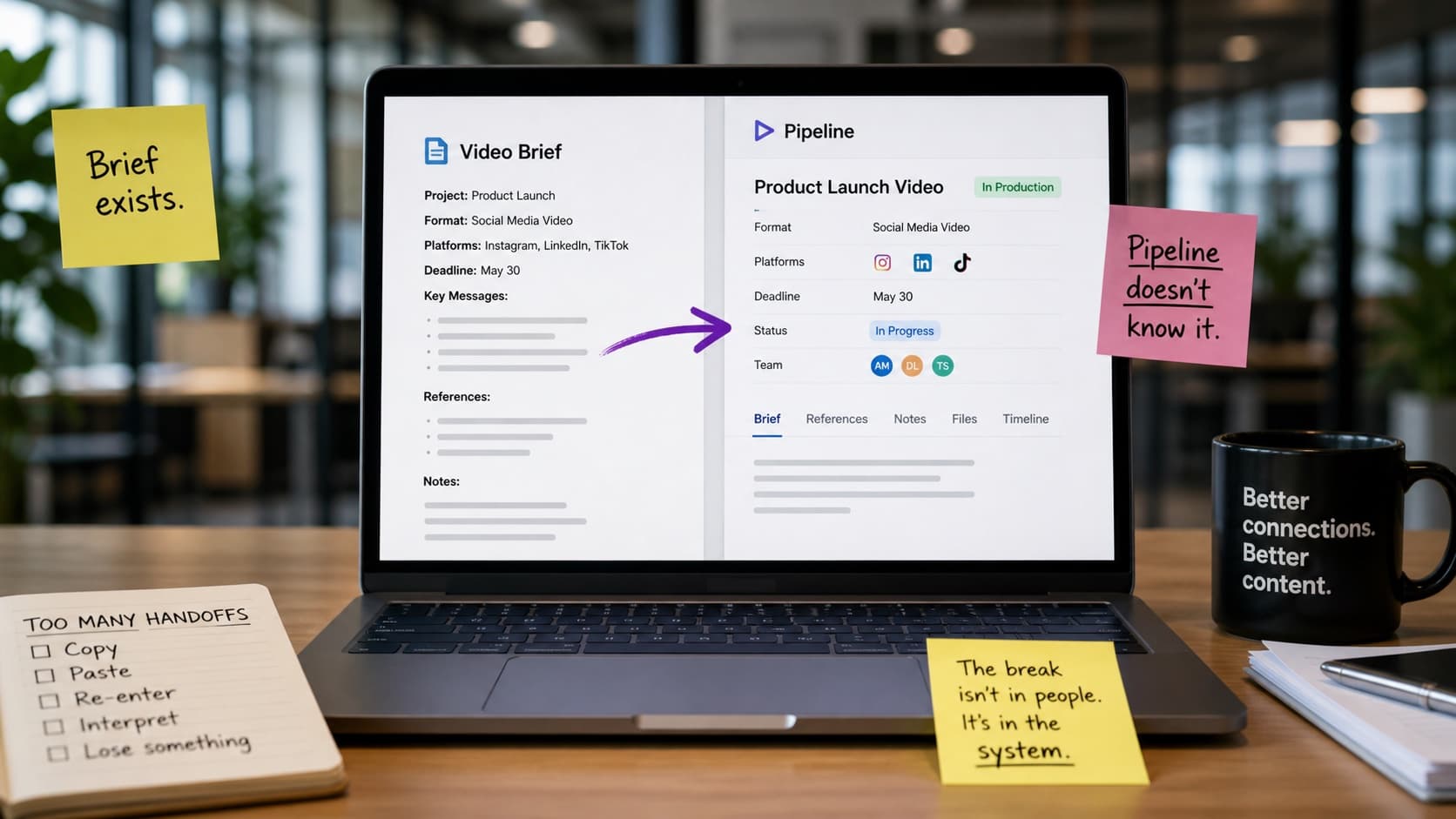
In most production teams, the brief exists. It's in a Google Doc, an email, a Slack thread, a Notion note. Someone took the time to write it. The information is there.
And yet, the moment a video enters the production management tool (Asana, Trello, Monday, whatever), someone has to re-enter it. Copy the topic, the format, the deadline, the constraints. Sometimes it gets done. Sometimes it's approximate. Sometimes it doesn't happen at all, and the task kicks off with whatever someone remembered from the meeting.
That's where information starts to get lost, not in an accident, but in the normal friction between tools that don't talk to each other.
The brief lives in one tool. Production in another. Feedback in a third. Stats in a fourth. Each does its part correctly. Nobody connects them. And at every handoff between tools, something gets distorted or disappears.
It's not a discipline problem.
The cost is hard to measure because it doesn't show up in any dashboard. It shows up as questions: "do you have the brief somewhere?" "which one is the final version?" "where were the client notes again?" Time spent looking for things that should have been findable immediately.
The most visible symptom is the first cut coming back with notes that should have been in the brief. In TV or ad production, it rarely happens. The shoot is too organized, too expensive to start without everything locked down. In social media, with lighter productions and shorter timelines, the approximate brief has become the norm. We shoot and see. And "we'll see" gets paid back in revision rounds.
The break gets fixed upstream
The answer wasn't a better briefing process. It was a link-shareable form, tied to an organization, accessible without an account.
The requester fills in: their name, the video type, the destination platform (which automatically triggers the associated format variations), the deadline, shoot dates if needed, the brief, the contributors, the constraints, the reference links. The draft saves automatically on every change. Multiple people can work on the same form at the same time: a project manager sets the format, a contributor specifies their constraints, a client adds their references. Everything saves without prior coordination.
The token is single-use: once submitted, the link is consumed. The submission doesn't generate an email. It creates the project directly in the pipeline, with all its information intact. Nobody re-enters. Nobody interprets. The project exists in the system in the exact state it was written.
Documentation doesn't fix the break
The obvious response to information loss is to document better. Create a convention, train teams, impose a standard brief format. Most organizations that hit this problem respond with discipline.
We tried both, actually. Discipline first, then the tool. Discipline held for a few months. It doesn't fix the structural problem. It adds a human constraint to compensate for a tool's limitation. And human constraints hold until they don't: a busy stretch, a new team member, a client following up urgently.
Even with a solid brief and established processes (that's the case in many more structured productions), the break between the brief tool and the production tool exists. Someone pays the re-entry cost, even when everything else is done right.
When the brief is the project's origin in the system, everything that comes after accumulates in the same place. Revisions, feedback, status, files. You don't search, you look. And the history exists by design, not because someone remembered to write it all down.
What that makes possible afterward is a read that fragmented tools can't offer. Which formats get requested most. Where incomplete briefs slow down production. Which clients or teams generate the most volume. Most teams have this information somewhere. It's just in too many places to actually see it.